
Fan technology helps you manage the people you already know. Growth depends upon understanding the people you don’t.
Over the past few weeks, we’ve argued that behavioural data doesn’t explain itself, and that owning fan data doesn’t necessarily mean understanding the fan…an emotional, motivational, attitudinal level.
A single customer view, that brings together every behavioural touchpoint may create an impressively complete record of someone’s interactions, but it doesn't reveal the human being that produced them.
Oh, and we discussed how CRM, however sophisticated, is infrastructure…not fan strategy.
So, all of this leads us, dear reader, to the rather significant commercial problem at the centre of this series of SFF articles:
Your next fans aren’t in your CRM.
Whether you’re an artist, manager, label, promotor, agent or even DSP, that matters, because growth is the goal?
Your future fans aren’t in your CRM because:
They haven’t bought anything.
They haven’t joined anything.
They haven’t subscribed, registered, downloaded, scanned, followed, pre-saved or attended.
They may not even think of themselves as fans.
And because they haven’t yet entered your system, most of your fan technology cannot see them.

Your future fans aren’t in your CRM they haven’t yet entered your system - your fan technology can't see them.
THE DATABASE BEGINS TOO LATE
Most fan technology begins after somebody has completed an identifiable action. So, a CRM record appears because they purchased a ticket, joined a mailing list, entered a competition or downloaded an app.
A fan-engagement platform begins working once they register.
A community platform becomes relevant after they decide to join.
A loyalty programme can reward them once they start participating.
All of these technologies can be extremely valuable, but they begin after the most important breakthrough has already occurred:
Somebody has demonstrated sufficient interest to identify themselves.
That means the technology is principally designed to organise, engage, activate and monetise people who have already crossed a threshold. But who is thinking about everybody on the other side of that threshold?
THE AUDIENCES BEYOND THE SYSTEM
An artist’s future audience might include:
Someone who recognises three songs but has never explored further
A former fan who quietly drifted away
A younger listener encountering a catalogue track through a film, game or social post
A fan of a comparable artist who has never been given a compelling introduction
Someone who would connect deeply with the artist’s values, story or identity but has never encountered them in the right context
A passionate music fan who knows the name but misunderstands what the artist represents
For a sports organisation, growth might come from:
Local families who have never considered attending
Casual viewers with no attachment to a particular club
Lapsed supporters whose lives or priorities have changed
Fans of the sport who feel excluded from the traditional match-day experience
Cultural communities living close to the stadium but having little relationship with the organisation
People competing in the sport recreationally who have never developed an affinity with the professional game
These people are not necessarily indifferent. Some may be latent fans: people with the potential to care deeply if they encounter the right song, story, experience or invitation. Others may be adjacent audiences whose existing interests, beliefs and identities provide a natural bridge. Hey, some may already have a spark of interest but face a practical or emotional barrier. Others may hold misconceptions that prevent them from exploring further. But none of those opportunities can be found simply by analysing the people already inside the database.
The opportunity becomes clearer when we look beyond the identifiable centre of the audience:
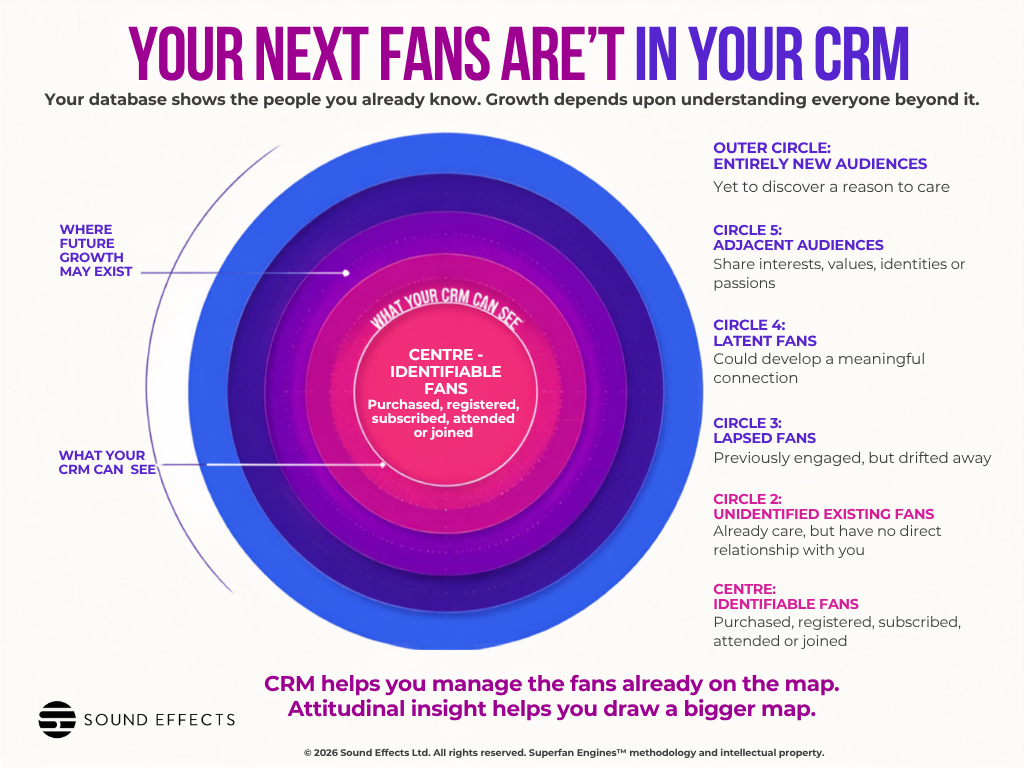
CRM sees the identifiable centre. Future growth may exist in the audiences beyond it.
GROWTH DOESN’T ALWAYS LOOK LIKE YOUR EXISTING FANBASE
This is where organisations can become trapped by their own data. The clearer the picture of the existing audience becomes, the greater the temptation to search for more people who look and behave exactly like them. To be brutal, it’s easier, and it’s cheaper, and that's why it’s done.
If most identifiable fans are men over 45, we target more men over 45.
If vinyl buyers respond strongly to heritage content, we create more heritage content for vinyl buyers.
If existing supporters live within twenty miles of the venue, we search for similar households within the same radius.
That may improve short-term efficiency, but it can also reinforce the audience you already have.
The next generation of fans may not look like the current generation. They may enter through different songs, stories, cultural interests and experiences. And a new supporter may not share the demographic profile or attendance behaviour of a season-ticket holder. They may connect with completely different aspects of the music, the game, the artist, the club or the whole sport.
If we define future potential exclusively through the behaviour of existing customers, we risk excluding the very people capable of creating growth.
START WITH THEIR WORLD
Finding new fans doesn’t mean selecting a large demographic and exposing them to more advertising. As we say, write and present again and again: “Let’s target Gen Z” is not an audience strategy. Nor is commissioning younger influencers to promote the same familiar songs or assuming discounted tickets will automatically attract local families. I’m not trying to be facetious, but all of these are still presented to us as some kind of revolutionary ‘strategy’.
People, we need - no, we must - understand where a meaningful connection could exist.
What does this artist, club or sporting experience contain that particular people could recognise themselves within?
Which values, emotions, identities, stories or cultural tensions might create relevance?
What are people seeking that the current proposition does not provide?
What prevents initial curiosity from developing into a relationship?
And what would allow them to move from recognising something to deciding:
“This is for people like me.”
That requires us to break out of the organisation’s database and enter the audience’s world. Not merely examining what people have done around us, but understanding their wider lives, motivations, needs, passions, misconceptions and competing choices.

NEW FANS ARE ONLY PART OF THE OPPORTUNITY
Once we understand people in this way, we don’t simply discover more effective marketing messages, we might identify:
New audiences and cultural communities
More relevant positioning
New products and experiences
Previously unseen revenue opportunities
Better brand partnerships and sponsorships
New content, stories and creative routes
Barriers preventing participation or conversion
More meaningful audience segments
Better ways to use CRM and engagement technology
Opportunities to reduce creative and commercial risk
This is the point where insight stops being treated as an interesting description of the audience and becomes a source of commercial growth.
Suppose research reveals that a group of casual listeners feels a powerful connection with the values surrounding an artist but finds the traditional fan culture excluding. That doesn’t simply produce a new advertising segment. It might inspire different storytelling, a new live experience, an unexpected collaboration, a community initiative or a brand partnership capable of giving that audience a credible route into the artist’s world.
Similarly, if local non-attendees see a sports club as distant from their community, the answer may not be another ticket promotion. The opportunity might involve local participation, different match-day experiences, community partnerships, new membership models or a complete repositioning of what the club offers beyond the fixture itself.
The insight changes what the organisation creates, not merely who receives the CRM-generated email.
MAKING EXISTING TECHNOLOGY MORE VALUABLE
Ok, let’s make this crystal clear yet again: this is not an argument against CRM, fan-engagement technology or community platforms. Superfan Engine is not designed to replace any of them. But, it makes them more efficient, more effective and more valuable.
Insight can reveal which audiences matter, what motivates them, how they differ, what barriers prevent engagement and what form of relationship they actually want.
CRM can then help organise and activate those relationships.
Engagement technology can deliver more relevant experiences
Community platforms can serve people who genuinely value deeper participation.
Content, partnerships, sponsorship and communications can be built around human understanding rather than assumption.
The technology provides the machinery, but it's Insight that provides the direction.
That relationship between human understanding, technology and growth looks like this:
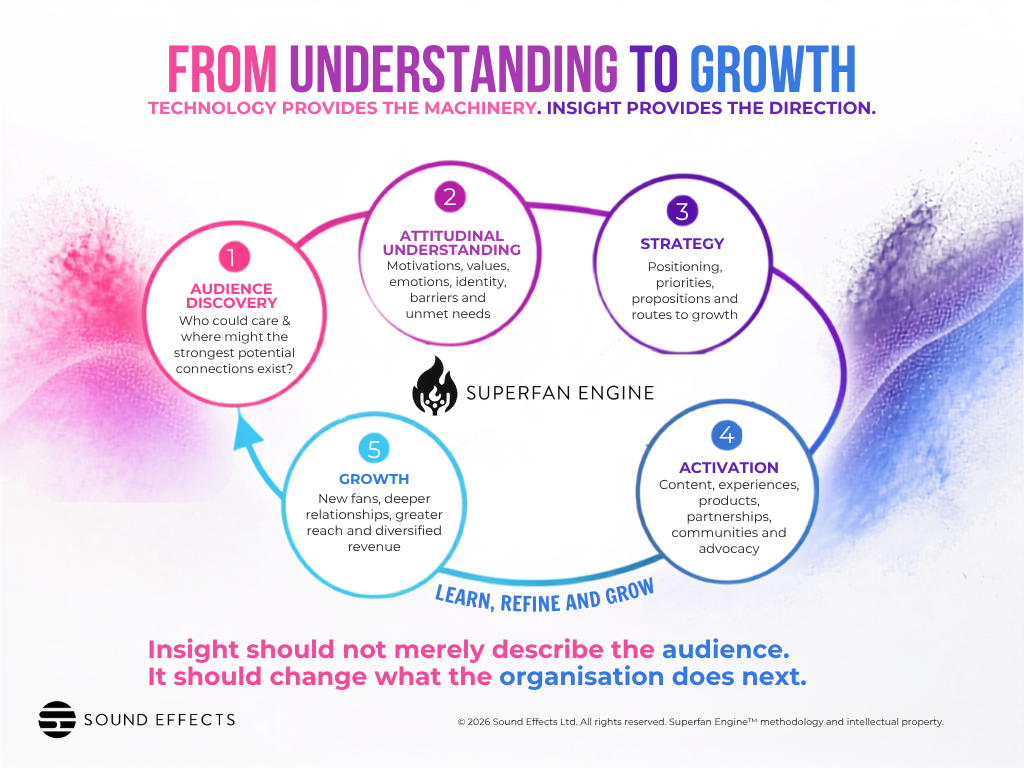
Superfan Engine turns audience understanding into strategy, activation, learning and growth.
DRAWING A BIGGER MAP
A CRM can communicate with the fans already on the map. The Superfan Engine helps draw a bigger map.
It identifies latent and adjacent audiences, reveals why they could care and helps organisations create the propositions, experiences and commercial opportunities capable of turning potential into participation.
Because sustainable growth will not come simply from communicating more frequently with the same identifiable people, or extracting more money from those who already spend the most.
It will come from understanding who else could care, what would create genuine value for them and how that new relationship could create value for the organisation in return.
Your current fans may be recorded in extraordinary detail.
Your next fans are still invisible.
They are not waiting in your CRM.
They are waiting to be understood.
YOUR NEXT FANS AREN’T IN YOUR CRM.
BUT THEY DON’T HAVE TO REMAIN UNKNOWN.
If you’re an artist, manager, sports club or rights-holder trying to grow beyond the audience already visible in your data, Superfan Engine can help you identify who could connect next, understand why, and build the relationship that turns potential affinity into active fandom.
If that is a question your team is trying to answer, let’s talk.
If this made you think differently about fan growth, please subscribe to The Superfan Formula and share it with someone responsible for audience strategy.