A label may have exceptionally detailed information about recorded-music consumption. It can see streams, territories, playlists, campaign responses, audience demographics and the performance of individual tracks.
All of that is valuable.
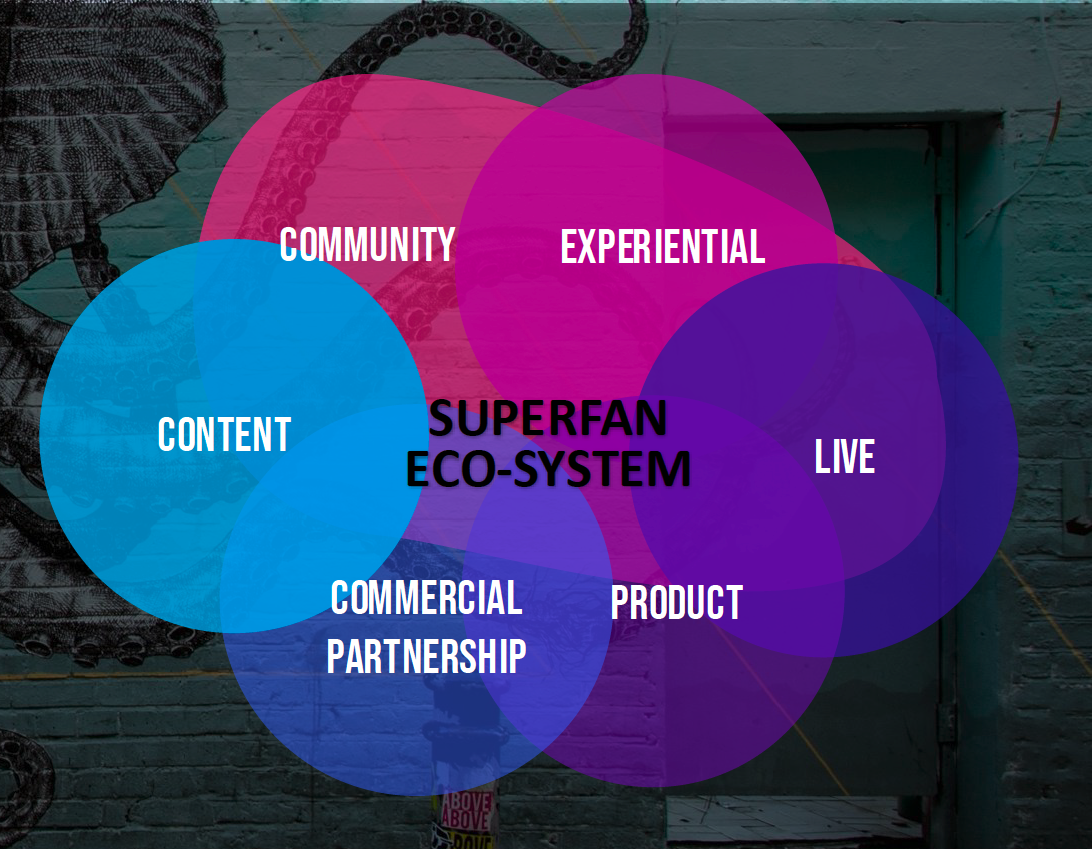
But recorded music represents only one part, albeit a hugely important one, of the wider fan ecosystem. It is still only one of six interdependent parts.
The Fan Experiences The Whole Artist
This makes perfect sense, of course. A fan doesn’t experience an artist through recordings alone. Their relationship may encompass a wide range of touchpoints: live performance, merchandise, diversified products, content, community, licensing, partnerships, experiences and wider culture.
Together, these can be understood through six interconnected areas of the fan ecosystem:
CONTENT - Includes recorded music
LIVE - Performance and other stuff
PRODUCT - merch, but a hell of a lot more
COMMUNITY - massive, diverse and underexploited
COMMERCIAL PARTNERSHIPS - includes cultural, JV some licensing etc
EXPERIENTIAL - different from LIVE
These aren’t separate relationships from the fan’s perspective. They’re different expressions of the same relationship with the artist.
A live show can renew interest in the catalogue. A piece of content can create discovery. Merchandise can make identity visible. A community can deepen belonging. A brand partnership can introduce the artist to an adjacent audience. An experience can turn passive affinity into active advocacy.
Each part affects the performance and value of the others.
Artist management is the only party with both responsibility and influence across that entire relationship and ecosystem.
The label doesn’t.
So, this creates a wee structural problem.
Fragmented Responsibility Creates Fragmented Insight
It makes little commercial sense for labels to keep adding budget, technology and headcount in an attempt to develop strategy across an artist ecosystem they neither control nor see in its entirety.
The label sees recorded-music behaviour. The promoter sees ticket sales. The merchandise partner sees transactions. The social platform sees content engagement. The brand partner sees campaign response. Each possesses a valuable, but necessarily partial, view of the fan.
The problem arises when one partial view is treated as though it represents the whole relationship. More behavioural data from one part of the ecosystem doesn’t necessarily produce a more complete understanding of the fan. It may simply provide an increasingly detailed picture of one particular behaviour.
Oh, and before any of my label friends message me…
Let me stress: this is not a criticism of labels.
It’s an argument, grounded in cold, hard commercial fact, for allowing them to concentrate on what they excel at: developing, promoting and growing recorded music.
The artist community and wider music business must recognise that the world’s largest record companies have changed their commercial models. And labels must recognise this too, and focus on what their businesses are now structured, equipped and incentivised to do exceptionally well.
Increasingly, that is asset management.
Management Must Become The Strategic Centre
The wider fan strategy should sit with artist management, supported by insight that management owns and which examines the fan’s entire relationship with the artist, not simply the behaviours visible within one part of it.
Management-owned insight creates a shared strategic foundation from which every specialist partner can work.
It can help the label understand which audiences and cultural opportunities might drive recorded-music growth. It can help promoters shape live experiences around what fans genuinely value. It can inform products, partnerships, content, community development and licensing without forcing each partner to begin with an isolated view of the audience.
This does not require management to replace those partners or reproduce their expertise. It enables management to provide the connective strategy that helps their individual expertise work together.
Where Sound Effects Fits
That is precisely why Sound Effects exists.
By working through artist management, we can identify what the artist means to fans, understand how the different parts of the ecosystem reinforce one another and uncover opportunities that no individual commercial partner could unlock alone.
Sound Effects doesn’t seek to replace the label, promoter, agent, merchandise company or brand partner. Our role is to give management an independent understanding of the fan relationship across the whole ecosystem.
That means going beyond what people streamed, bought, clicked or attended to understand why the artist matters to them: the motivations, values, identities and emotional connections driving those behaviours.
Management can then use that understanding to establish priorities, coordinate partners and make better commercial decisions across the artist’s entire business.
A Stronger Whole Benefits Everyone
The irony is that activity beyond the label’s direct control can benefit the label enormously.
A live experience can create discovery.
A community can deepen emotional connection.
A partnership can introduce the artist to an adjacent audience.
A diversified product can turn affinity into advocacy.
A cultural moment can send people back into the catalogue.
Streaming, discovery and catalogue value all grow when recorded music becomes part of a stronger whole.
Labels remain essential.
But they shouldn’t be expected to carry the whole artist strategy, because no single part of the fan ecosystem can understand or direct the whole.
If management is the only party with sight of the artist’s whole ecosystem, shouldn’t management also become its strategic centre?