

‘Come together with your hands’
Why artists should never confuse someone else's strategy with their own.
Last week I argued that artists and managers should never outsource ownership of fan understanding. This week I want to explain why.
In conversations with managers, I keep hearing a variation of the same question: “If that’s true, why are the major labels suddenly creating all these Strategy and Insight roles?”
It's a fair question. In fact, on the surface, it looks encouraging.
For years I've argued that our industry needs more strategic thinking, better audience understanding and a deeper appreciation of fandom. Seeing words like Strategy, Audience, Insight and Catalogue Strategy appearing across organisational charts should, surely, be a good sign. Perhaps it is. But I also think there's a danger. Not because those roles exist, but because artists and managers may draw the wrong conclusion from them.
The assumption seems to be that if an organisation starts talking more about strategy, it has somehow become strategically aligned with artist development. I don't think that's necessarily true.
Because strategy doesn't begin with a job title, it begins with a business model. And the business model always wins.
STRATEGIC FOR WHOM?
Every organisation has a strategy.
Warner has one
Goldman Sachs has one
Nike has one
Manchester City has one
The interesting question isn’t whether an organisation has a strategy. It is: Who is that strategy designed to serve? That’s a very different conversation.

Coz their strategic direction might be the opposite to yours? You see what i did there?
STRATEGY FOLLOWS INCENTIVES
Back in Article 27, I suggested that the biggest shift in the modern music business wasn't another restructure or another round of redundancies, but actually a change in the underlying business model.
The largest record companies on the planet have gradually evolved into sophisticated rights businesses, increasingly resembling asset managers, accountable to shareholders, measured against quarterly performance and increasingly focused on portfolio management, capital efficiency and catalogue optimisation.
That single change explains almost everything that has happened over the past five years.
The restructures
The redundancies
The increasing focus on catalogue
The drive for operational efficiency
The changing profile of senior hires
Even the growing use of words like Strategy and Insight
They aren't isolated decisions; they're logical consequences of a business model that has fundamentally changed. And this isn't criticism, it's simply reality. And a reality that matters. Because every business model creates incentives, and incentives shape strategy. Always.
This is why changing job titles doesn't necessarily change strategic priorities. You can move people. Restructure departments. Create new functions. Rename existing ones. You can put that word Strategy almost anywhere on an organisational chart. But none of those things changes what the organisation is fundamentally designed to achieve. Strategy follows incentives, not vocabulary and changing the vocabulary does not change the incentives.
This is where I think many managers are making a mistake. They're looking at these new roles and thinking: "Great...the label is becoming more strategic." Maybe. But strategic for whom? That's the question. The strategy may be excellent; it just isn't necessarily your strategy.
Because if the commercial model is increasingly optimised around recorded music, rights management, catalogue performance and shareholder returns, then that's exactly where strategy will naturally concentrate. Not because people don't care, but because that's the job.

the little teal plan is artist management, boldly heading off on their strategy, while all their partners...see what i mean?
THE ECOSYSTEM IS BIGGER THAN THE LABEL
Now compare that with the job of artist management. The manager isn't responsible for one part of the business. As we discussed last week, they're responsible for all of it.
Recorded music
Touring
Merchandise
Publishing
Brand partnerships
Fan relationships
Licensing
Content
Direct-to-fan
Future opportunities that don't even exist yet.
Last week, I described this as the Fan Ecosystem. The record company is responsible for an incredibly important part of that ecosystem, but it is still only one part.
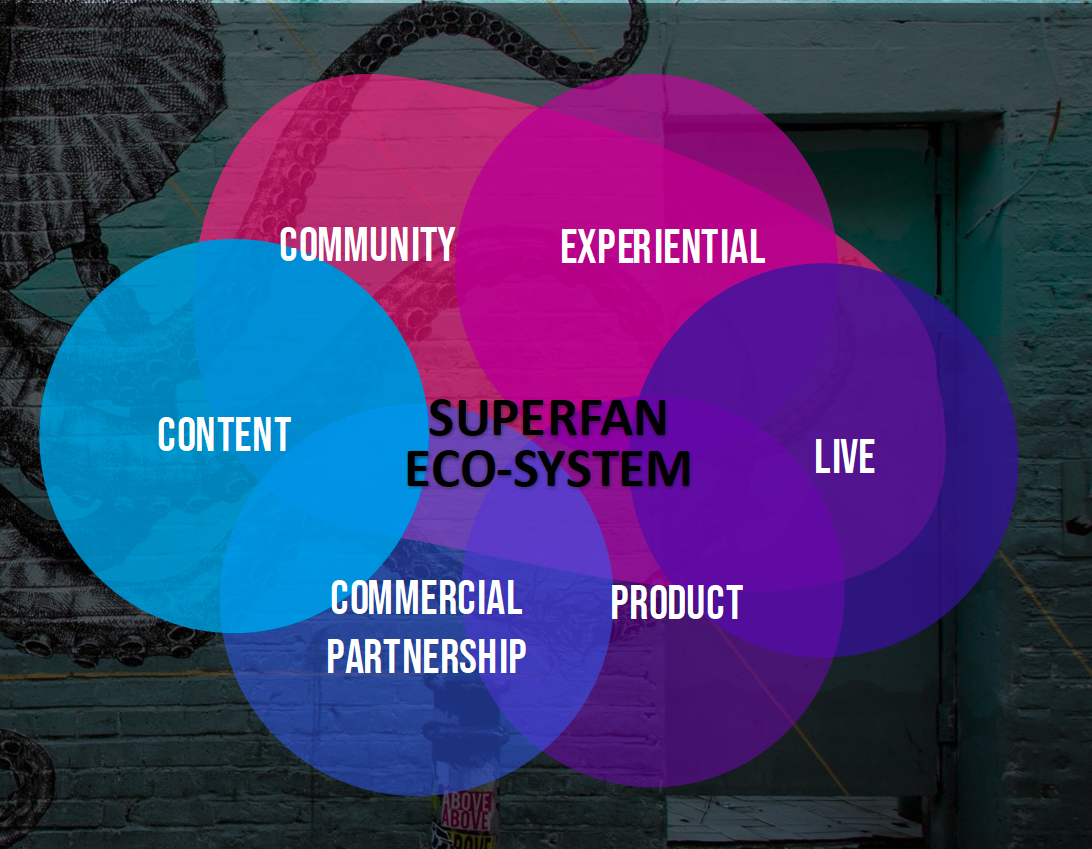
fan or superfan ecosystem...whichever, but its the fans that construct it. No one else.
So why would the strategy for the entire ecosystem sit inside one organisation whose commercial responsibility naturally focuses on only one section of it? It shouldn't, not because record companies are incapable, but because the ecosystem is bigger than the record company.
Ironically, I think this should strengthen the relationship between managers and labels. Stop expecting the label to become something it was never designed to be. Instead, allow it to become exceptional at what it already does.
Recorded music.
Marketing.
Global distribution.
Release execution.
Artist development within the recording business.
That's an extraordinary contribution, but it's different from owning the strategy for an artist's entire career. That responsibility belongs somewhere else. It belongs with the artist and their management.
MANAGEMENT CAN NOW OWN THE STRATEGY
Twenty years ago, that would have been much easier to say than to do as managers simply didn't have access to the strategic tools. Behavioural insight was prohibitively expensive. Large-scale audience understanding sat almost exclusively inside the biggest organisations. If you wanted genuine strategic audience intelligence, you usually had to rely on someone else.
That's changed.
Today, management can own fan understanding. It can own attitudinal insight, arguably the most valuable, and certainly the most elusive, form of audience understanding. Managers can arrive at label meetings with evidence instead of assumptions and make informed decisions across the entire Fan Ecosystem.

the eco-system revolving around the artist...get it...clever... I’m good with these picture…heh?
Artist management no longer has to borrow strategy from somebody else’s business. It can own it. That is one of the biggest shifts the music business has seen in decades.
So please don't mistake a change in language for a change in direction. Don't assume that because an organisation talks more about strategy, its strategy is automatically aligned with yours. Great labels need strategy. Of course they do. But it is strategy designed to make the label successful.
Management’s responsibility is different: to make the artist successful.
Those two objectives often overlap. Sometimes they don’t. That is precisely why management must own the strategy, not because labels matter less, but because artists need someone whose incentives are aligned with the whole career.
The smartest managers won’t spend the next decade asking labels to become different businesses. They will build the strategic capability to become better managers.
FINAL THOUGHT
Great labels should continue doing what they do brilliantly. Great managers must stop waiting for strategy to arrive from elsewhere and start owning it.
Because the future won't belong to the managers with the biggest labels. It will belong to the managers with the clearest strategy.